Enterprise Cloud & Infrastructure: A Complete Guide
A vendor-neutral overview of enterprise cloud and infrastructure as a single coherent capability. Learn how migration, cost, security, and modernization reinforce one another, plus the pitfalls that cause cloud programs to underdeliver.
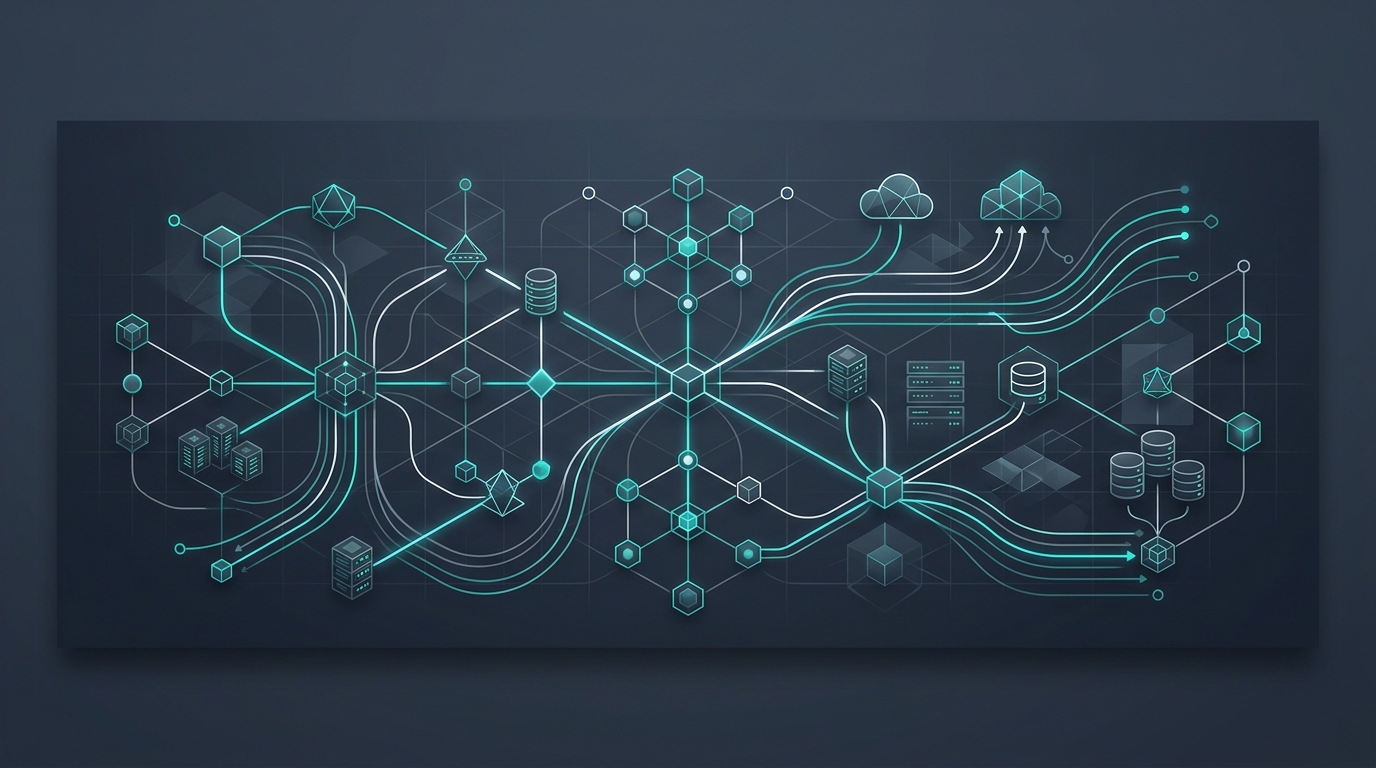
Enterprise cloud and infrastructure is the discipline of designing, operating, and governing the compute, storage, networking, and platform services that run a modern organization's workloads. For most enterprises, the cloud is no longer a single project or a destination — it is the operating substrate beneath nearly every application, data pipeline, and customer interaction. This guide offers a broad, vendor-neutral overview of how to think about enterprise cloud as a coherent capability rather than a collection of disconnected accounts and tools, and it links to deeper material for each area where the real work happens.
The conversation has matured. Early cloud adoption was framed around cost savings and elasticity. Today the decisive questions are about resilience, security posture, regulatory exposure, and whether infrastructure can change at the pace the business demands. Getting those answers right is an architectural and organizational challenge as much as a technical one, and it sits within the broader practice of enterprise IT consulting services.
What Enterprise Cloud and Infrastructure Actually Covers
At enterprise scale, "the cloud" spans several distinct concerns that are easy to conflate:
- Compute and runtime — virtual machines, containers, serverless functions, and the orchestration layers (commonly Kubernetes) that schedule them.
- Data and storage — object stores, managed databases, caching tiers, and the durability and replication guarantees behind them.
- Networking and connectivity — VPCs, private links, hybrid connections to on-premises systems, and edge delivery.
- Identity and governance — who can do what, under which policy, with what audit trail.
- Platform and tooling — the internal developer platform, CI/CD pipelines, and observability that make all of the above usable by teams.
A defining trait of enterprise environments is that these concerns rarely live in one place. Multi-account structures, multiple regions, and frequently more than one cloud provider are the norm. That distribution is what turns straightforward technical tasks into governance problems.
Why It Matters for Enterprise Organizations
Infrastructure decisions compound. A naming convention, an account boundary, or a network topology chosen in year one constrains what is feasible — and what is affordable — for years afterward. Three pressures make this strategic rather than operational:
- Resilience and continuity. Customers and regulators expect availability measured in fractions of a percent. Architecture, not heroics, determines whether an organization meets that bar.
- Cost as a board-level concern. Cloud spend has become one of the largest and least predictable line items in many IT budgets. Without discipline, it grows faster than the workloads it supports.
- Security and compliance exposure. A misconfigured storage bucket or an over-permissioned role is now a board-reportable event, not a footnote.
The organizations that succeed treat infrastructure as a product with owners, a roadmap, and measurable service levels — not as a cost center to be minimized until something breaks.
This product mindset is the thread that connects migration, cost, security, and modernization into a single strategy rather than four competing initiatives. Our cloud services practice is built around exactly that integration.
A Practical Framework
We find it useful to organize enterprise cloud work into four interlocking domains. Each is broad enough to warrant dedicated treatment, and each is covered in depth in its own guide.
| Domain | Core question | Primary risk if ignored |
|---|---|---|
| Migration | How do we move workloads safely and incrementally? | Stalled "lift-and-shift" with no modernization payoff |
| Cost | How do we control spend without throttling delivery? | Runaway bills, reactive cuts that break things |
| Security & compliance | How do we prove we are safe and compliant? | Breaches, failed audits, regulatory penalties |
| Modernization | How do we keep infrastructure evolvable? | Accumulating technical debt, slowing change |
Migration is where most enterprise journeys begin, and where the most value is lost to poor sequencing. A disciplined, wave-based method — assessing dependencies, grouping workloads, and proving each wave before the next — beats a big-bang cutover every time. We lay out that method in A Phased Approach to Enterprise Cloud Migration.
Cost optimization follows naturally, because migrated workloads almost always run inefficiently at first. The goal is durable savings achieved through right-sizing, commitment management, and architectural change — not blunt cuts that introduce fragility. The techniques, and the guardrails that keep them safe, are detailed in Cloud Cost Optimization: Cutting Spend Without Risk.
Security and compliance must be designed in, not bolted on. Identity-first access, encryption by default, continuous configuration scanning, and audit-ready evidence are the foundation for meeting frameworks such as SOC 2, ISO 27001, and PCI DSS. We cover the controls and the operating model in Cloud Security and Compliance for Enterprises.
Modernization is the long game: replacing brittle patterns with managed services, adopting infrastructure as code, and treating environments as reproducible rather than hand-built. The strategies for doing this without destabilizing production are in Cloud Infrastructure Modernization Strategies.
These four domains reinforce one another. Modernization makes cost optimization sustainable; security shapes how migration waves are sequenced; cost discipline funds further modernization. Treating them in isolation is the most common reason cloud programs underdeliver.
Common Pitfalls
In our work with enterprise teams, the same failure patterns recur:
- Lift-and-shift as the finish line. Moving workloads unchanged captures the migration risk without the modernization reward, and often raises costs.
- No clear account and landing-zone strategy. Provisioning accounts ad hoc creates a governance backlog that is painful to unwind later.
- Security treated as a release gate, not a default. Controls applied at the end are weaker, slower, and resented by delivery teams.
- Cost visibility without accountability. Dashboards that no one owns change nothing; spend only moves when teams see — and answer for — their own usage.
- Tooling sprawl. Every team adopting its own pipeline and observability stack multiplies cost and erases the consistency that makes scale manageable.
- Ignoring the operating model. The hardest part of cloud is rarely the technology; it is deciding who is responsible for what, and giving them the platform to act.
Avoiding these is less about any single tool choice and more about establishing clear ownership, sensible defaults, and a willingness to revisit decisions as the estate grows.
Key Takeaways
- Enterprise cloud is an operating substrate spanning compute, data, networking, identity, and platform — treat it as one coherent capability, not scattered accounts.
- Infrastructure decisions compound; resilience, cost, and compliance are strategic concerns that belong on the leadership agenda.
- Organize the work into four reinforcing domains — migration, cost, security and compliance, and modernization — and address them together.
- Sequence migration in waves, design security in by default, pursue durable cost savings, and modernize continuously rather than in big-bang projects.
- Most cloud programs underdeliver because of a weak operating model, not weak technology — establish ownership, defaults, and accountability first.